Stainless Steel Mesh Strainer Welding Process | HEQIA HARDWARE
HEQIA HARDWARE · FACTORY INSIGHTS & PRECISION MANUFACTURING
Precision Welding Behind Every Stainless Steel Mesh Strainer: A Closer Look at HEQIA HARDWARE Manufacturing
What makes a reliable stainless steel mesh strainer? While the appearance of a finished kitchen utensil may seem simple, its performance depends on many manufacturing details, including material selection, basket forming, structural assembly, welding quality, and finishing workmanship.
Among these manufacturing stages, welding plays an important role in connecting metal components and maintaining the intended structure of the finished product.
At HEQIA HARDWARE, we recognize the importance of careful workmanship in stainless steel kitchenware manufacturing. From wire skimmers to fine mesh strainers, each product design requires suitable production techniques and attention to structural details.
In this article, we take a closer look at the welding process used in stainless steel mesh strainer manufacturing and explain why skilled operators, accurate component positioning, and quality considerations matter to international wholesale buyers.
Inside the Workshop: The Art of Stainless Steel Mesh Strainer Welding
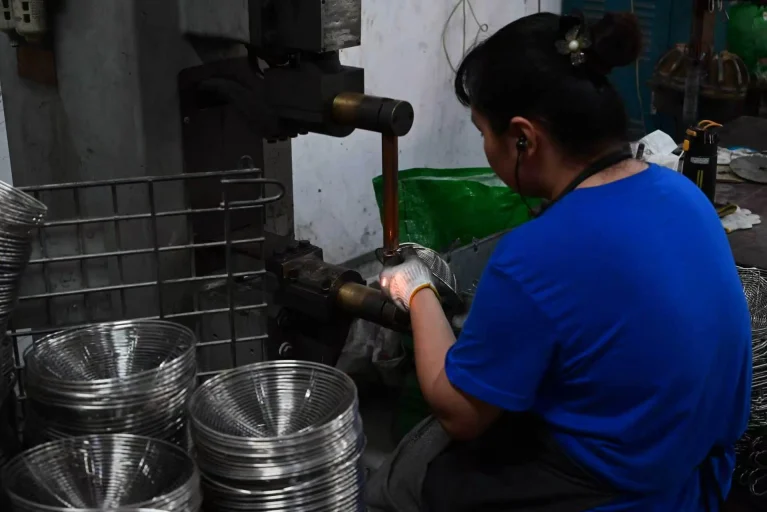
The factory photograph captures a skilled operator working at a welding station while wearing a protective welding helmet and gloves. A bright welding arc illuminates the stainless steel components being joined, while stacks of circular mesh strainer baskets are arranged nearby.
This scene illustrates the hands-on manufacturing work involved in producing stainless steel kitchen utensils.
Although modern equipment provides the necessary welding functions, the operator remains responsible for positioning components, controlling the welding operation, and handling the workpiece.
For stainless steel mesh strainers, accurate joining is especially important because the finished utensil combines fine metal mesh, supporting frames, and handle structures.
Each component must work together to create a practical kitchen tool suitable for draining, filtering, and transferring food ingredients.
Why Welding Quality Matters in Stainless Steel Kitchenware
Welding is a widely used manufacturing method for joining metal components. In stainless steel kitchenware production, it can be used to connect supporting frames, metal wires, handle structures, and other components according to the product design.
The quality of these connections can influence the structural integrity, appearance, and practical usability of the finished utensil.
For mesh strainers, welding quality is particularly relevant because the basket and handle must remain properly aligned during normal kitchen operations.
- Structural Stability: Properly formed welded connections help maintain the intended relationship between metal components.
- Basket Alignment: Accurate joining helps preserve the circular shape and structural arrangement of the strainer.
- Handle Connection: Suitable welding methods can contribute to a stable connection between the basket support and handle structure.
- Consistent Appearance: Controlled welding helps reduce unnecessary variations in visible joining areas.
- Manufacturing Precision: Accurate component positioning supports consistency across products of the same specification.
- Product Durability: Appropriate welding procedures contribute to the overall construction of kitchen utensils intended for repeated use.
For international wholesalers and kitchenware distributors, these details are important considerations when evaluating product quality.
The Role of Skilled Workers in Precision Welding
Manufacturing equipment is an important part of metalworking, but skilled operators remain essential in many welding and assembly processes.
During manual welding, operators must carefully position the workpiece, maintain suitable welding conditions, and coordinate their movements with the equipment.
Even small differences in component positioning can influence the appearance and alignment of the finished product.
For this reason, attention to detail is particularly important when working with thin metal components and circular mesh structures.
The photograph demonstrates the importance of operator involvement, showing a worker concentrating on the welding area while handling the metal components directly.
This combination of technical equipment and hands-on workmanship is a characteristic feature of many stainless steel kitchenware manufacturing operations.
Understanding the Structure of a Stainless Steel Mesh Strainer
A stainless steel mesh strainer generally consists of several interconnected components. Understanding their functions helps explain why accurate assembly and welding are important.
1. Fine Stainless Steel Mesh
The mesh is the primary filtering component of the strainer. Its small openings allow liquids to pass through while helping retain food ingredients and smaller particles.
Mesh density, wire diameter, and basket dimensions influence the product’s filtering characteristics.
2. Circular Supporting Frame
The circular frame supports the mesh basket and helps maintain its intended shape.
Proper frame construction is important because it provides structural support around the basket opening.
3. Reinforcement Components
Depending on the product design, additional metal wires or supporting structures may be incorporated to help reinforce the basket.
These components must be positioned appropriately to maintain the intended basket structure.
4. Handle Connection
The handle connects the basket to the user’s grip and influences how conveniently the utensil can be operated.
Different strainers may feature stainless steel handles, tubular handles, wooden handles, bamboo handles, or other handle designs.
The connection between the basket and handle must be suitable for the intended product structure and application.
From Metal Mesh to Finished Strainer: The Manufacturing Process
Stainless steel mesh strainer manufacturing involves several interconnected stages. Although the exact process varies according to the product model and manufacturing equipment, the following steps are commonly involved.
Step 1: Material Preparation
Production begins with preparing the required stainless steel mesh, metal wire, supporting frames, and handle components.
Material specifications should be selected according to the intended product design and market requirements.
Step 2: Mesh Cutting and Basket Forming
The stainless steel mesh is cut and shaped into the required basket configuration.
Accurate forming helps maintain consistent basket dimensions and prepares the component for subsequent assembly.
Step 3: Frame Positioning and Assembly
The formed mesh basket is combined with its supporting frame and other structural components.
Careful positioning helps maintain the intended circular shape and alignment of the basket.
Step 4: Precision Welding
Selected metal components are joined using suitable welding techniques.
During this stage, operators must pay attention to component positioning and the welding requirements of the specific product design.
Appropriate welding conditions help create the intended connections while limiting unnecessary distortion of thin metal components.
Step 5: Handle Assembly
After the basket structure is prepared, the handle components are assembled according to the product specifications.
Handle length, material, and attachment design vary between different kitchen strainer models.
Step 6: Surface Finishing
Finishing operations help improve the appearance of metal components and address unwanted manufacturing marks or exposed sharp edges.
Appropriate finishing is particularly important for kitchen utensils that are frequently handled during food preparation.
Step 7: Product Inspection
Before products are prepared for distribution, relevant specifications and visible structural details should be examined.
Inspection considerations may include basket dimensions, mesh condition, frame alignment, welding connections, handle stability, and surface appearance.
Why Thin Stainless Steel Components Require Careful Welding
Stainless steel mesh strainers often contain relatively thin metal wires and lightweight structural components.
These materials require careful handling during welding because excessive heat or unsuitable welding conditions may affect their shape and appearance.
Potential manufacturing concerns can include unwanted distortion, inconsistent joining points, and damage to nearby mesh structures.
For this reason, manufacturers should select appropriate welding methods and operating parameters according to the material thickness and product design.
Careful component positioning and suitable welding procedures help support more consistent manufacturing results.
The Importance of Welding Safety in Metalworking
Welding operations involve intense light, heat, and potential exposure to sparks and fumes. Appropriate protective measures are therefore important in manufacturing environments.
The photograph shows an operator wearing a welding helmet and protective gloves while working with metal components.
Protective equipment is an important part of safe welding practices, together with suitable ventilation, equipment maintenance, and appropriate operating procedures.
Workplace safety should be considered alongside product quality when evaluating manufacturing processes.
How Welding Quality Influences Product Consistency
For wholesale kitchenware production, consistency is an important consideration because buyers often purchase multiple units of the same product model.
Products within the same specification should maintain reasonably consistent dimensions, basket shapes, handle alignment, and structural construction.
Welding is one of the manufacturing stages that can influence these characteristics.
- Consistent Joint Positioning: Helps maintain the intended arrangement of connected components.
- Basket Shape: Proper positioning helps reduce unwanted variations in circular basket structures.
- Handle Alignment: Accurate joining supports consistent handle positioning.
- Surface Appearance: Suitable welding and finishing practices contribute to a more uniform product appearance.
- Structural Construction: Properly formed connections support the intended product design.
- Product Evaluation: Clear inspection criteria help buyers compare products within the same specification.
For international distributors, consistent product specifications make it easier to manage kitchenware collections and communicate purchasing requirements.
Quality Control Considerations for Welded Stainless Steel Strainers
When evaluating welded stainless steel strainers, buyers should consider both visible workmanship and relevant product specifications.
Although the appropriate inspection methods depend on the product design and purchasing requirements, several areas deserve particular attention.
Weld Appearance
Inspect visible welded areas for irregularities, excessive material buildup, or other apparent defects.
Basket Alignment
Check whether the basket maintains its intended shape and dimensions.
Mesh Condition
Examine the mesh for broken wires, damaged openings, or unwanted deformation.
Handle Stability
Review the connection between the basket and handle according to the intended product construction.
Surface Finishing
Check for exposed sharp edges, unwanted burrs, and other visible finishing concerns.
Dimensional Consistency
Verify relevant measurements, including basket diameter, overall length, and product weight.
These considerations help buyers assess whether a product matches the required specifications and intended applications.
Stainless Steel Mesh Strainers for Different Kitchen Applications
Stainless steel mesh strainers are versatile kitchen tools used for draining, filtering, and transferring food ingredients.
Their fine mesh construction makes them suitable for tasks requiring smaller openings than traditional open-wire skimmers.
- Restaurant Kitchens: Practical for draining ingredients during food preparation.
- Vegetable Preparation: Suitable for rinsing and draining vegetables.
- Noodle Cooking: Convenient for lifting and draining cooked noodles.
- Cooking Liquid Filtering: Helps separate suitable food particles from liquids.
- Catering Operations: Useful for various food preparation and draining tasks.
- Household Kitchens: Practical for everyday cooking and ingredient preparation.
- Commercial Kitchen Supply: Available in different specifications for various kitchen requirements.
Buyers should select the appropriate mesh fineness, basket size, and handle design according to the intended use.
What International Wholesale Buyers Should Look For
For kitchenware importers and distributors, product evaluation involves more than comparing prices.
Material specifications, manufacturing workmanship, structural design, and product consistency are all important purchasing considerations.
Before placing a bulk order for stainless steel mesh strainers, buyers should review the following details.
- Stainless Steel Material: Confirm the required material grade and relevant specifications.
- Mesh Construction: Review mesh fineness, basket structure, and filtering requirements.
- Welding Workmanship: Examine visible joining points and structural connections.
- Basket Dimensions: Verify the required diameter, depth, and overall length.
- Handle Design: Select suitable handle materials and connection structures.
- Product Weight: Confirm weight specifications for the selected model.
- Sample Evaluation: Request samples when necessary to examine actual product construction.
- Order Quantity: Provide the required quantity for each product specification.
- Packaging Requirements: Confirm suitable packaging methods for transportation.
- Production Lead Time: Discuss the estimated manufacturing schedule according to order requirements.
Clear communication regarding these factors helps buyers select products that match their business needs and target markets.
HEQIA HARDWARE: Practical Stainless Steel Kitchenware for Wholesale Markets
At HEQIA HARDWARE, we focus on stainless steel kitchenware products designed for practical cooking and food preparation applications.
Our collection includes stainless steel wire skimmers, mesh strainers, four-wire strainers, double-fork strainers, austenitic stainless steel strainer models, and kitchenware sets.
Different basket structures, handle designs, and product dimensions provide options for household kitchenware retailers, restaurant equipment distributors, and international wholesale buyers.
We understand that accurate product information is important when sourcing kitchen utensils. Our product listings provide item numbers, dimensions, weights, and available specifications to help customers compare different models.
Whether you are sourcing stainless steel mesh strainers or other kitchenware products, HEQIA HARDWARE welcomes inquiries regarding product specifications and wholesale purchasing requirements.
Frequently Asked Questions
1. Why is welding important in stainless steel mesh strainer manufacturing?
Welding connects selected metal components and helps maintain the intended structural arrangement of the strainer basket, supporting frame, and handle.
2. What are the main components of a stainless steel mesh strainer?
A typical stainless steel mesh strainer includes a fine mesh basket, circular supporting frame, reinforcement components, and a handle structure.
3. Why does welding require skilled operators?
Skilled operators help position components accurately, manage the welding operation, and handle the workpiece according to the product’s manufacturing requirements.
4. What should buyers inspect when evaluating welded mesh strainers?
Buyers should review welding connections, basket alignment, mesh condition, handle stability, surface finishing, and product dimensions.
5. Are stainless steel mesh strainers suitable for commercial kitchens?
Yes. Suitable stainless steel mesh strainers are commonly used in restaurants, catering operations, and commercial kitchens for draining and filtering food ingredients.
6. What is the difference between mesh strainers and wire skimmers?
Mesh strainers generally feature finer openings for filtering smaller ingredients, while open-wire skimmers typically have wider openings for lifting and draining larger foods.
7. What kitchenware products does HEQIA HARDWARE offer?
HEQIA HARDWARE offers stainless steel mesh strainers, wire skimmers, four-wire strainers, double-fork strainers, austenitic stainless steel strainer models, and other kitchenware products.
8. How can wholesale buyers request product information?
Please contact HEQIA HARDWARE with your preferred product name, item number, size, required quantity, and any relevant packaging requirements to request additional product specifications and wholesale purchasing information.
Discover the Craftsmanship Behind HEQIA HARDWARE Kitchenware
From stainless steel mesh forming to precision welding and structural assembly, the manufacturing of kitchen strainers involves multiple processes that contribute to the finished product.
The combination of suitable equipment, skilled operators, and careful manufacturing practices helps support consistent product construction.
Explore the HEQIA HARDWARE stainless steel kitchenware collection and discover practical mesh strainers, wire skimmers, and other kitchen utensils for your business.
HEQIA HARDWARE – Stainless Steel Strainers & Kitchenware Manufacturer